JLPT N5 Adjectives List: I-Adjectives & Na-Adjectives
Complete JLPT N5 adjectives list: i-adjectives (ookii “big”, chiisai “small”, oishii “delicious”) and na-adjectives (kirei “pretty”, shizuka “quiet”, benri “convenient”). Essential vocabulary for describing people, places, food, and feelings in Japanese.
Japanese Adjectives Basics
Japanese adjectives are divided into two main types: i-adjectives and na-adjectives.
I-adjectives end with 〜い ...i (for example, おおきい ookii - big, ちいさい chiisai
- small, あたらしい atarashii - new).
Na-adjectives work like nouns and use 〜な before a noun (for example, きれいなへや
clean room, しずかなへや quiet room).
I-adjectives: おいしい oishii - delicious; tasty、たかい taklai - expensive; high、やすい
yasui - cheap/inexpensivet …
Na-adjectives: きれい kirei - beautiful; pretty; clean、ゆうめい yuumei- famous、しずか
shizuka- quiet、べんり benri - convenient
Some na-adjectives end with 「い (i)」 (for example, きれい kirei、ゆうめい yuumei).
They are not i-adjectives. You will see them in the list below.
I-Adjectives & Na-Adjectives Conjugation Examples
JLPT N5 adjectives change form for tense (present/past) and polarity (positive/negative). See examples below:
JLPT N5 must-know patterns - present (+/-) and past (+/-):
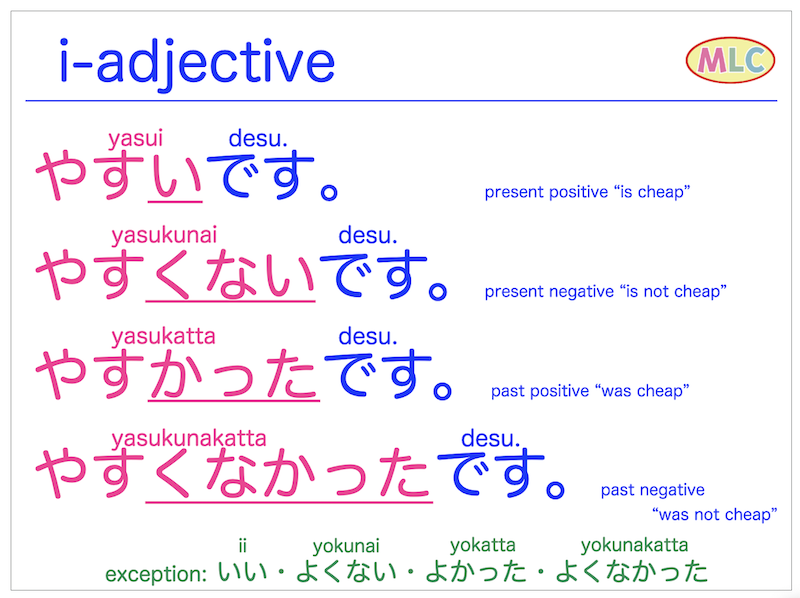
i-adjective:
Present + やすいです (yasui desu - cheap)
Present - やすくないです (yasukunai desu - not cheap)
Past + やすかったです (yasukatta desu - was cheap)
Past - やすくなかったです (yasukunakatta desu - wasn't cheap)
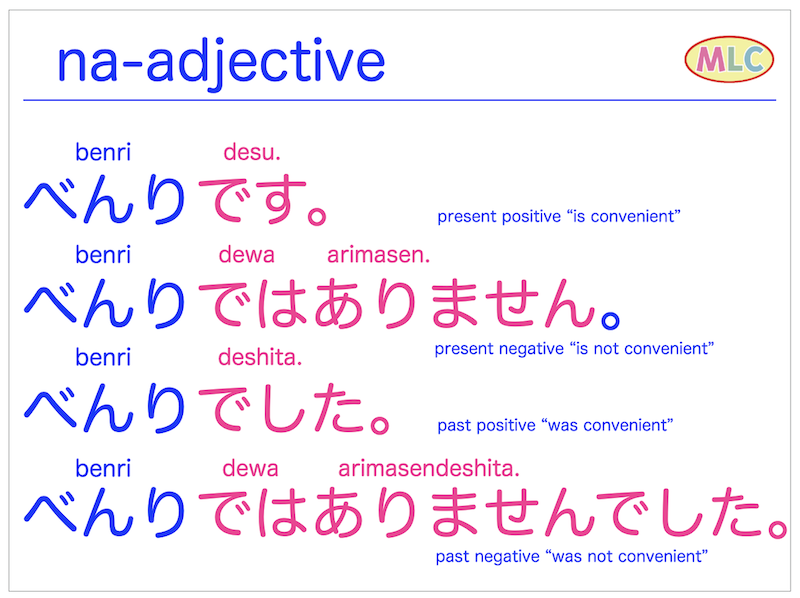
na-adjective:
Present + べんりです (benri desu - convenient)
Present - べんりではありません (benri dewa arimasen - not convenient)
Past + べんりでした (benri deshita - was convenient)
Past - べんりではありませんでした (benri dewa arimasendeshita - wasn't convenient)
Key Points:
I-adjectives: Drop い(i) → く(ku) + ない(nai) / かった(katta) / くなかった (kunakatta)
Na-adjectives: Use です(desu)/ではありません(dewaarimasen)/でした(deshita)/ではありませんでした(dewaarimasendeshita) + な(na) (before nouns)
Degree Words with Adjectives
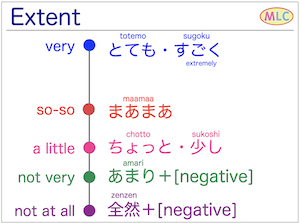
Make your adjectives stronger or weaker:
- とても あついです (totemo atsui desu - very hot)
- ちょっと/すこし あついです (chotto/sukoshi atsui desu - a bit hot)
- あまり あつくないです (amari atsukunai desu - not very hot)
- ぜんぜん あつくないです (zenzen atsukunai desu - not at all hot)
JLPT N5 Adjectives: Complete List (I & Na-Adjectives)
Complete reference sheet with all i-adjectives and na-adjectives for JLPT N5 exam preparation. Print-ready format with kana and English meanings.
Kanji learning included (高い, 安い, 新しい…)
I-Adjectives
Complete JLPT N5 i-adjectives list - see PDF for kanji readings
- i-adj. Level 1: おおきい、ちいさい、たかい、やすい、あたらしい、ふるい、いい、わるい、むずかしい、やさしい、とおい、ちかい、おいしい、まずい、いそがしい
- i-adj. Level 2: あつい、さむい、つめたい、あたたかい、すずしい、おもしろい、つまらない、せまい、ひろい
- i-adj. Level 3: たかい、ひくい、ながい、おもい、かるい、つよい、よわい、くらい、あかるい、あかるい、かわいい
- i-adj. Level 4: あまい、からい、あつい、うすい、ふち、ほし、わかい
- i-adj. Level 5: すくない、おおい、いたい、きたない、あぶない、うるさい、たのしい、ほしい
Na-Adjectives
Download PDF for kanji (上手, 有名...) and full list
- na-adj. Level 1: きれい、ゆうめい、ていねい、すき、きらい、しずか、ひま、にぎやか、べんり、げんき、いろいろ
- na-adj. Level 2: だいじょうぶ、じょうぶ、へん、らく、いや、たいせつ、じょうず、へた
Na-Adjectives that End with “i”
Important Exception: These adjectives look like i-adjectives (end in い) but are actually na-adjectives. Always use 〜な before nouns.
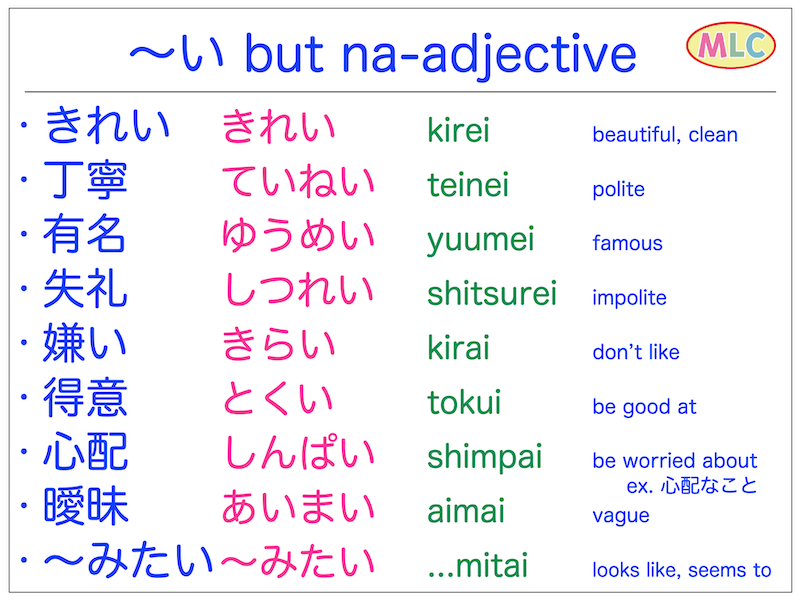
JLPT N5 Focus List (use 〜な before nouns)
- きれい kirei = beautiful; pretty; clean
- ていねい teinei = polite
- ゆうめい yuumei = famous
- しつれい shitsurei = impolite
- きらい kirai = don't like
- とくい tokui = be good at
Other na-adj. that end with "i": 得意(とくい)、心配(しんぱい)、曖昧(あいまい)、意外(いがい)、重大(重大)、予想外(よそうがい)、有害(ゆうがい)、透明(とうめい)、愉快(ゆかい)、安易(あんい)、やっかい、余計(よけい)、幸い(さいわい)、おっちょこちょい、冷静(れいせい)、無関係(むかんけい)…
Reference: 104 Adjectives List (N5-N4)
This expanded list contains 104 adjectives from JLPT N5 to N4 levels.
Use alongside the JLPT N5 complete list above for comprehensive adjective mastery
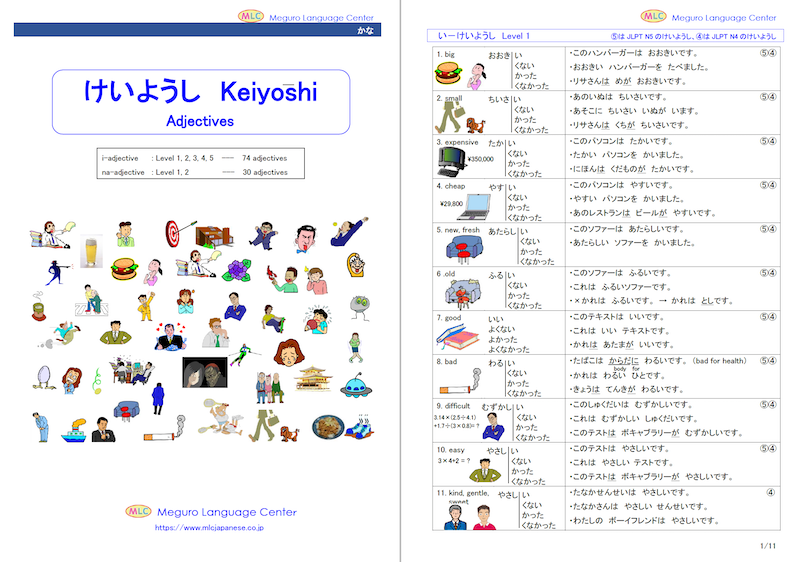
- Download 104 Adjectives Reference List in Hiragana and Katakana - Free PDF
- Download 104 Adjectives Reference List in Romaji - Free PDF
JLPT N5–N4 Video Lessons: 104 Japanese Adjectives
Video 1: Pronunciation Practice
Learn 104 Japanese Adjectives Slowly — 74 i-adj + 30 na-adj (JLPT N5/N4)
Master 104 high-frequency Japanese adjectives at a slow, easy-to-follow
pace, perfect for JLPT N5–N4 beginners.
This video covers 74 i-adjectives and 30 na-adjectives with clear pronunciation
and natural conjugation patterns you can repeat and shadow.Study without
background music and use the free 104 adjectives PDF to review vocabulary
while you watch.
Video 2: Grammar Practice
104 Japanese Adjectives | i-adjectives & na-adjectives (Present Positive & Negative)
Learn 104 essential Japanese adjectives with both present positive and
present negative forms for JLPT N5–N4 study.
This grammar-focused video reviews 74 i-adjectives and 30 na-adjectives,
example sentences, and key rules for adjective conjugation in Japanese.Use
it together with the i-adjective & na-adjective explanation and the
downloadable 104 adjectives list linked on this page.
Next Steps: Advanced Adjective Forms
Ready for the next step? Learn adjective connective forms:
Master noun (で), i-adjective (くて), na-adjective (で) connections
Updated Jan 2026