JLPT N5/N4: "De" vs "Ni" for Locations - Usage Guide
Many JLPT N5/N4 learners struggle with when to use "de" (で) versus "ni" (に) for locations. This guide explains the key differences: use "ni" for existence or targets (e.g., がっこうに います。Gakkou ni imasu. - I am at school), and "de" for actions at a place (e.g., がっこうで べんきょうします。Gakkou de benkyou shimasu. - I study at school). Master these tips for natural-sounding Japanese!
"De" marks where actions happen, "Ni" marks existence/destination
![[place]+de, [place]+ni](img/file44.png)
"De" for Actions at Places
Use "de" (で) to indicate where an action takes place. It pairs with verbs of action (べんきょうします benkyou shimasu = study、しごとをしますshigoto o shimasu = work etc.).
- うちで べんきょうします。Uchi de benkyou shimasu. (uchi = home) =I study at home.
- かいしゃで しごとを します。 Kaisha de shigoto o shimasu. (kaisha = company; office)
=I work at the office.
"Ni" for Directions and Goals
Use "ni" (に) to show the direction, target, or goal of movement or action. It pairs with いきます ikimasu = go, きます kimasu = come, かえります kaerimasu = return;go home (motion verbs).
- がっこうに いきます。Gakkou ni ikimasu. がっこうへ いきます。 Gakkou e ikimasu. (gakkou = school)
=I go to school.
"Ni" for Existence
Use "ni" (に) to indicate where someone/something exists or is located. It pairs with です desu / います imasu (static state verbs).
- がっこうに います。Gakkou ni imasu.= I am at school.
- とうきょうに すんでいます。Tokyo ni sunde imasu.= I live in Tokyo.
Gakkou ni ikimasu (がっこうに いきます) vs. Gakkou e ikimasu (がっこうへ いきます)
Both mean "I go to school," but with subtle nuance.
"Ni" (に) marks the target point - you arrive at the destination.
"E" (へ) shows direction - you're heading toward somewhere.
Quick Tip: Use "ni" for arrival, "e" for movement direction!
Example sentences
Practice these example sentences to master "de" (で) and "ni"
(に)!
Read them aloud, memorize the patterns, and use them in your own sentences.
Repetition is key to natural Japanese. Try speaking these today!
- MLC で べんきょうします。MLC de benkyou shimasu. = I study at MLC.
- うちで テレビを みます。Uchi de terebi o mimasu. = I watch TV at home.
- かいしゃで しごとを します。Kaisha de shigoto o shimasu. = I work at the office.
- にほんに きます。Nihon ni kimasu. = I come to Japan. (destination)
- きょうとに いきます。Kyouto ni ikimasu. = I go to Kyoto. (destination)
- 6じに うちに かえります。6-ji ni uchi ni kaerimasu. = I return home at 6 o'clock.
- テーブルの うえに えんぴつが あります。Teeburu no ue ni empitsu ga arimasu. = There's a pencil on the table
- かばんの なかに PCが あります。Kaban no naka ni PC ga arimasu. = The PC is inside the
bag.
- となりの へやに せんせいが います。Tonari no heya ni sensei ga imasu. = There's a teacher in the next room.
Video: Learn Japanese Particles で・に - 90 Example Sentences with Slow & Natural Speed
Watch 90 practical examples of "de" and "ni" particles! Perfect for mastering usage through repetition.
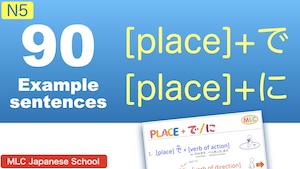
→ Video: Learn Japanese Particles で・に 90 Example Sentences with Slow & Natural Speed - JLPT N5 Grammar
Download worksheet (PDF)
Download this free PDF worksheet to practice "de" (で) and "ni"
(に) particles!
Fill in the blanks with correct particles, check your answers, and master
location expressions for JLPT N5/N4. Perfect for daily practice at home
or MLC classes!
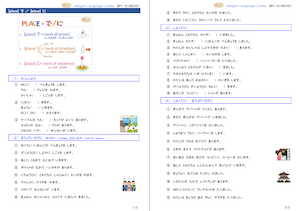
- [place]+de, [place]+ni (Roma-ji version)
- [place]+de, [place]+ni (Roma-ji version) -Answer
- [place]+で, [place]+に (かな version)
- [place]+で, [place]+に (かな version) - Answer
- [place]+で, [place]+に (漢字 version)
- [place]+で, [place]+に (漢字 version) - Answer
Video: Real-Life "De" (で) vs "Ni" (に) Examples
See "de" (で) and "ni" (に) particles used in everyday situations!
Perfect for JLPT N5/N4 learners who want practical, natural Japanese.
![[place]+で / [place]+に](img/image29.jpeg)
Video: How to Use Japanese Particles で and に for Places | Beginner Grammar Lesson
Updated Jan 2026 - "De" (で) vs "Ni" (に) mastery enhanced
with:
・N5/N4 level expansion - Covers both beginner levels
・Split explanations - Existence, Directions, Actions clearly separated
・20+ real example sentences with romaji & English translations
・"Ni" vs "E" nuance explained for natural Japanese