JLPT N5 Go, Come, Return Verbs
Learn how to talk about movement in Japanese for JLPT N5 using ikimasu (go), kimasu (come), and kaerimasu (return/go home). This lesson explains how to use the particles ni and e for destinations and de for means (by train, by bike, by email) with clear example sentences like “Shibuya ni ikimasu,” “MLC e kimasu,” and “Nihongo de hanashimasu.”
行きます いきます ikimasu= go
来ます きます kimasu= come
帰ります かえります kaerimasu= return; come back; go home
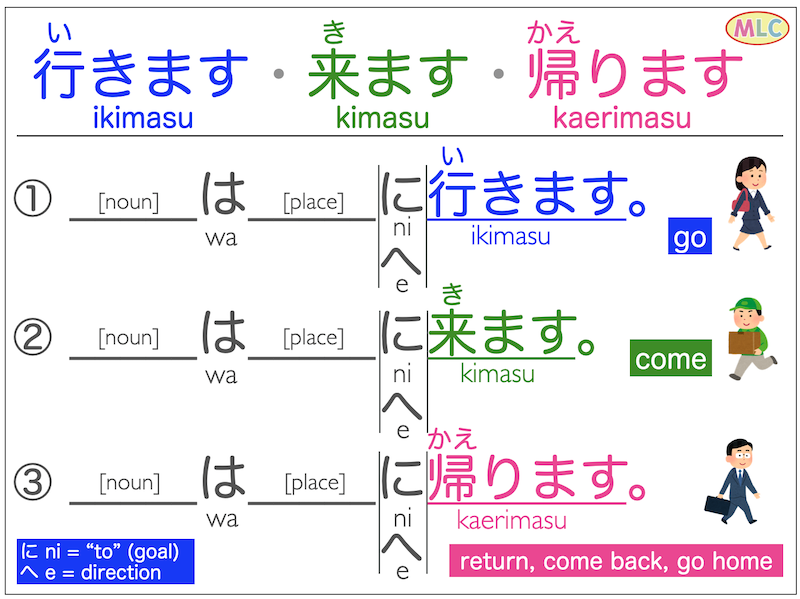
- わたしは しぶやに/へ いきます。Watashi wa Shibuya ni/e ikimasu. = I go to Shibuya.
- わたしは MLCに/へ きます。Watashi wa MLC ni/e kimasu. = I come to MLC.
- わたしは うちに/へ かえります。Watashi wa uch ni/e karimasu. = I go back homei
- がっこうに/へ いきます。Gakkou ni/e ikimasu. =(I) go to school.
Ni vs E Particles
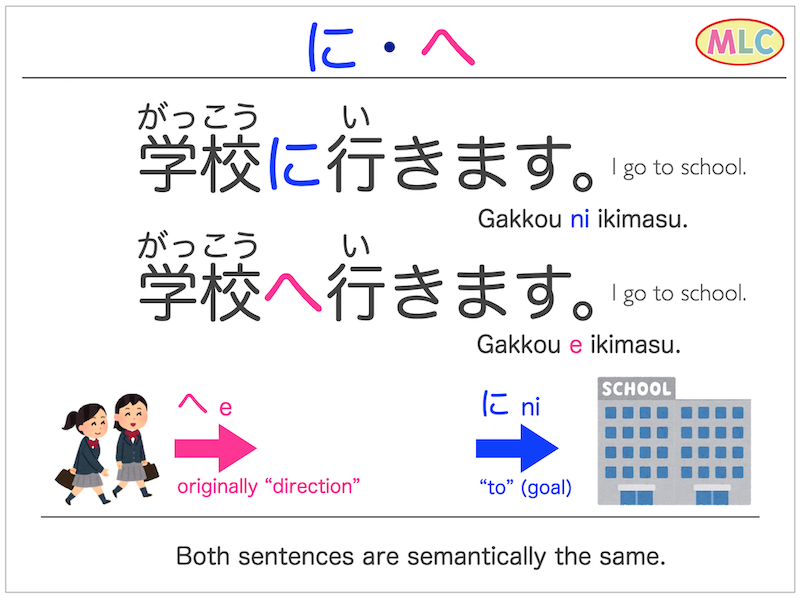
- に ni = to, "goal"
- へ e = originally "direction"
- がっこうに いきます。Gakkouniikimasu. = (I) go to school.
- がっこうへ いきます。Gakkoueikimasu. = (I) go to school.
Note: Ni and e are often interchangeable for simple movement verbs like
ikimasu, kimasu, and kaerimasu (e.g., gakkou ni/e ikimasu). However, only
ni is used for “to someone” with verbs like aimasu (to meet) and agemasu
(to give), so “tomodachi ni aimasu” is correct, but “tomodachi e aimasu”
is not.
ex.
こちらに どうぞ。Kochira ni douzo. = Lit. To here, please.
こちらへ どうぞ。Kochira e douzo. = Lit. To here/this way, please.
うちに かえります。Uchi ni kaerimasu. = Lit. (I) return/go back to home.
うちへ かえります。Uchi e kaerimasu. = Lit. (I) return/go back to home.
へ is pronounced “e” as a particle, “he” in other words.
ex. へん = hen (strange), 返事 へんじ henji = reply
”ni” and “e” are not always interchangeable.
ex.
ともだちに あいます。Tomodachi ni aimasu. = Lit. See/meet (my) friend. ←○
ともだちへ あいます。Tomodachi e aimasu. ←X
ともだちに プレゼントを あげます。Tomodachi ni purezento o agemasu. = (I) give a present to my friend. ←○
ともだちへ プレゼントを あげます。Tomodachi e purezento o agemasu. ←X
○= OK
X= no good
De for Means (By Train, Bike)
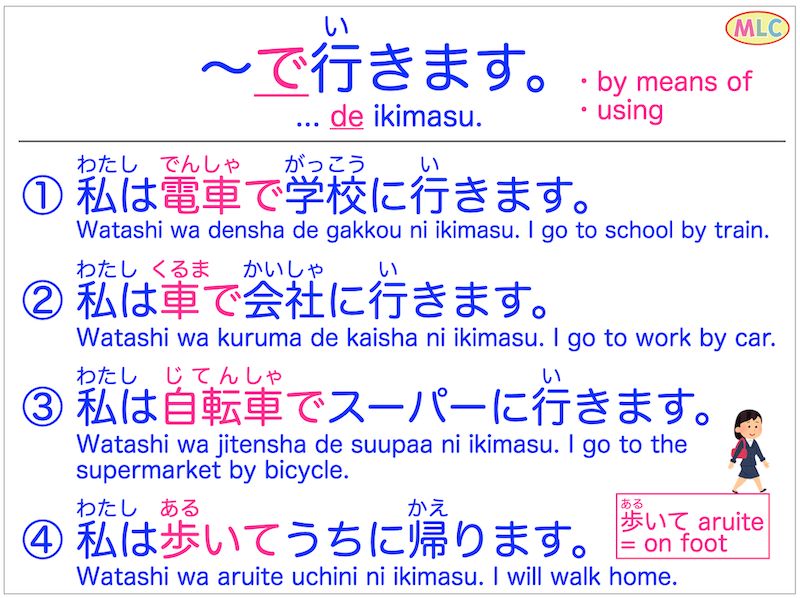
- わたしは じてんしゃで がっこうに いきます。Watashi wa jitensha de gakkou ni ikimasu. = I go to school by bicycle.
- わたしは でんしゃで ここに きました。Watashi wa densha de koko ni kimashita. = I came here by train.
- わたしは あるいて うちに かえります。Watashi wa aruite uchi ni kaerimasu. = I go back home on foot.
Example Sentences for Travel and Daily Life
- くるまで いきます。Kuruma de ikimasu. = Lit. (I) go by car.
- タクシーで きました。Takushii de kimasshita. = Lit. (I) came by taxi.
- じてんしゃで かえります。Jitensha de kaerimasu. = Lit. (I) go home/return by bicycle.
- メールで しゃしんを おくります。Meeru de shashin o okurimasu. = Lit. (I) send a picture by e-mail.
- ペンで かきます。Pen de kakimasu. = Lit. (I) write by pen.
- おはしで たべます。Ohashi de tabemasu. = Lit. (I) eat by chopsticks.
- にほんごで メールを かきます。Nihongo de meeru o kakimasu. = Lit. (I) write e-mail in Nihongo.(using Nihongo)
- にほんごで はなします。Nihongo de hanashimasu. = Lit. (I) speak in Nihongo.
- クレジットカードで はらいます。Kurejittokaado de haraimasu. = Lit. (I) pay by credit card.
- インターネットで にほんごを べんきょうします。Intaanetto de Nihongo o benkyou shimasu. = Lit. (I) study Nihongo by the internet.
- インターネットで チェックします。Intaanetto de chekku shimasu. = Lit. (I) check by ithe nternet.
- けいたいで PDFファイルを みます。Keitai de PDF fairu o mimasu. = Lit. (I) see PDF file by cell phone.
- スマホで しゃしんを とります。Sumaho de shashin o torimasu. = Lit. (I) take a picture by smartphone.
Updated Jan. 2026