JLPT N5 Adjective Conjugation: Connective Forms & Adverb Forms (Ku Kute Ni De)
Essential JLPT N5 grammar: Master adjective conjugation to connect sentences and create adverbs! Learn i-adjective changes: hayai (fast) → hayakute (connective), hayaku (adverb: walk fast). Na-adjective: jouzu (skillful) → jouzu de (connective), jouzuni (adverb: skillfully). Clear rules + examples for beginners — and practice!
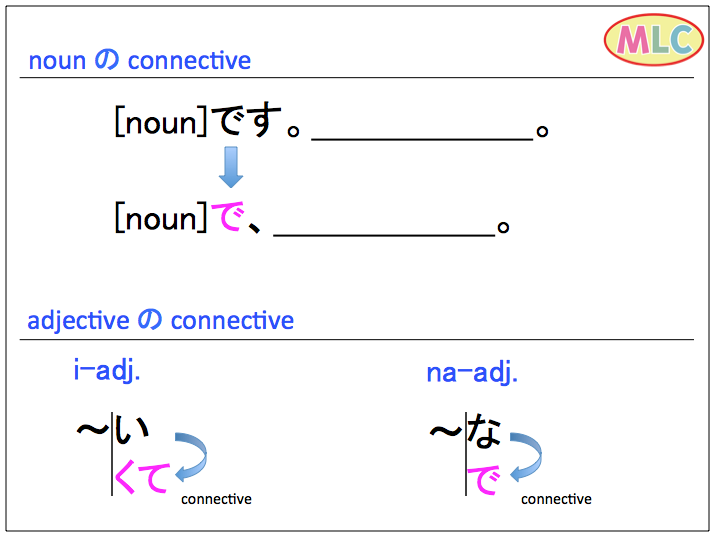
Noun Connective: ~です → ~で (JLPT N5)
- noun の connective: ~です。~。 → ~で、~。
Connect nouns with ~de instead of separate sentences.がくせいです。げんきです。→ がくせいで、げんきです。 (Student, and energetic). Use de to link noun states smoothly in JLPT N5 grammar!
I-Adjective Connective: ~い → ~くて (JLPT N5)
- i-adj. の connecive: ~い → ~くて
Link i-adjectives with ~kute form! はやい。やすい。→ はやくて、やすいです。 (Fast and cheap). Essential JLPT N5 pattern for describing multiple qualities together.
Na-Adjective Connective: ~な → ~で (JLPT N5)
- na-adj. の connecive: ~な → ~で
Connect na-adjectives using ~de! しずか(な)。べんり(な)。→ しずかで、べんりです。 (Quiet and convenient). Same de form as nouns—key JLPT N5 grammar rule!
I-Adjective Adverb: ~い → ~く (JLPT N5)
i-adj.: ~い → ~く
Turn i-adjectives into adverbs with ~ku! はやい (fast) → はやく (quickly): はやく あるきます (walk fast). あつい → あつく: あつく なりました (became hot). Essential for JLPT N5 action descriptions!
- はやい → はやく (はやく あるきます。 walk fast)
- あつい → あつく (あつく なりました。 became hot)
- さむい → さむく (さむく なりました。became cold)
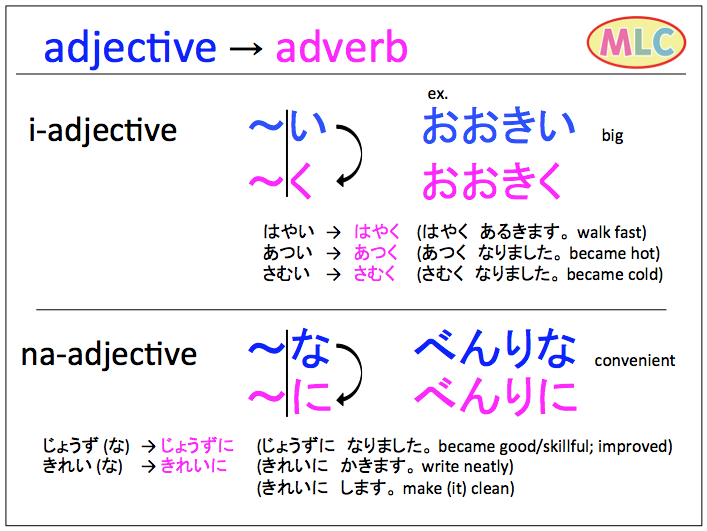
Na-Adjective Adverb: ~な → ~に (JLPT N5)
na-adj.: ~な → ~に
Convert na-adjectives to adverbs using ~ni! じょうず(な) → じょうずに: じょうずに なりました (became skillful). きれい(な) → きれいに: きれいに かきます (write neatly). Key JLPT N5 grammar pattern!
- じょう(な) → じょうずに (じょうずに なりました。become good/skillful; improved)
- きれい(な) → きれいに (きれに かきます。 write neatly)
(きれいに します。make (it) clean)
Updated Dec. 2025