Master 'Let's' in Japanese: ...mashou and ...mashou ka for JLPT N5
Master JLPT N5 volitional "mashou" form for suggestions: hajimemashou (let's start), ikimashou (let's go), shimashou ka (what shall we do?). Practice real conversations: "Dewa, hajimemashou" (Well then, let's get started), "Koohii o nomimasen ka?" → "Sou shimashou" (Let's have coffee). Essential for group invitations and proposals.
How to Form "...mashou" from Plain "...masu" Verbs
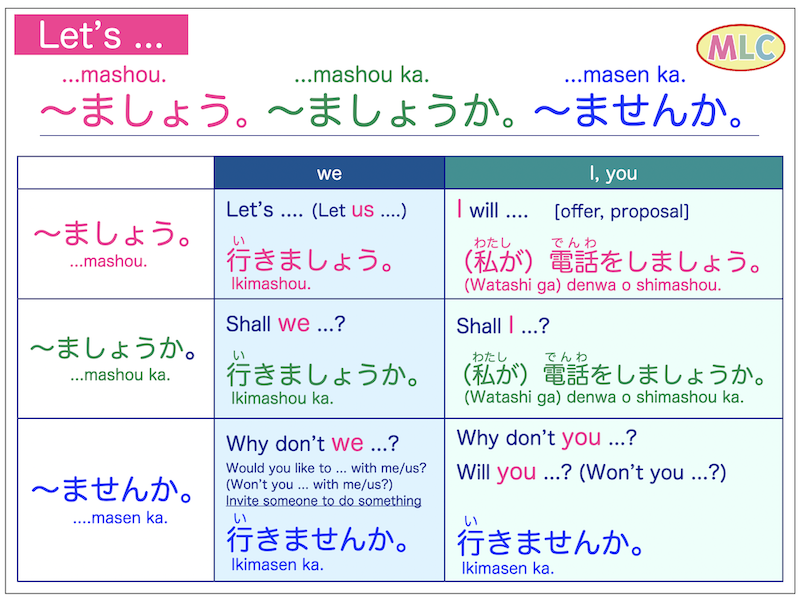
Click to enlarge: 3 key N5 patterns for suggestions (Ikimashou / Ikimashou ka / Ikimasen ka)
To create the "let's" form in JLPT N5 grammar, replace the "masu" ending of polite verbs with "mashou" for statements like "tabemasu" (eat) becomes "tabemashou" (let's eat). This volitional form is simple and used for suggestions. MLC Japanese breaks it down for beginners.
- いきましょう。Ikimashou. = Let's go.
- がんばりましょう!Gambarimashou! = Let's go for it!
- A: ちょっと やすみましょう。Chotto yasumimashou.= Let's have a break a little bit.
B: そうですね。そうしましょう。Sou desu ne. Sou shimashou.= That's right. Let's do so. - では、はじめましょう。Dewa, hajimemashou.= Well then,let's get started.
- A: じゃ、また、あいましょう!Ja, mata, aimashou! = Well, then, let's see again!
B: はい、じゃ、また!Hai, ja, mata! = Yes, well then, again.
Forming Questions: "...mashou ka" for "Shall We?"
Change "masu" to "mashou ka" to ask politely, e.g.,
"ikimasu" (go) turns into "ikimashou ka?" (shall we
go?). Perfect for N5 dialogues seeking agreement. Practice conjugating
common verbs like "nomimasu" to "nomimashou ka?" using
MLC examples.
- いきましょうか。Ikimashou ka. = Shall we go?
- では、はじめましょうか。Dewa, hajimemashou ka. = Well then, shall we get started?
- どうしましょうか。Dou shimashou ka. = What shall we do?
- しゅうまつは どこに いきましょうか。Shuumatsu wa doko ni ikimashou ka. = As for weekend, where shall (we) go?
"I Will..." Statements: Watashi ga ...mashou
State your intention to help with "(Watashi ga) ~mashou," e.g.,
"Kore wa watashi ga shimashou ka" (Shall I do this? → I will).
Pairs with thanks like "Tasukarimasu" (That helps). Essential
N5 pattern for volunteers or favors at MLC Japanese.
- (わたしが) メールしましょう。(Watashi ga) meeru shimashou. = I will e-mail.
- これは わたしが しましょう。Kore wa watashi ga shimasho. .= I will do this.
Offering Help: "Shall I ...?" with ...mashou ka
Use "(Watashi ga) ...mashou ka" to offer assistance politely in JLPT N5, like "Eigo o chekku shimashou ka" (Shall I check English?). Common in service scenarios; respond with "Onegaishimasu" (Please do). MLC examples show real dialogues for practice.
- (わたしが) メールしましょうか。(Watashi ga) meeru shimashou ka. = Shall I email?
- (わたしが)えいごを チェックしましょうか。(Watashi ga) eigo o chekku shimashou ka.= Shall I chek English
- これは わたしが しましょうか。Kore wa watashi ga shimashou ka.= As for this, shall I do?
Ikimasen Ka: Casual Invitations vs. ...mashou
While "mashou" suggests togetherness ("Ikimashou" -
Let's go), "ikimasen ka" invites softly ("Why don't we go?"
like eiga ni ikimasen ka). See thumbnail chart; MLC lessons clarify subtle
N5 differences for natural speech.
- いきませんか。Ikimasen ka. = Why don't you go?/Will you go?
- このみせに はいりませんか。Kono mise ni hairimasen ka.= Shall we go in this shop/restaurant?
- よかったら、この かさを つかいませんか。Yokattara, kono kasa o tsukaimasen ka.= I you like, would you like to use this umbrella?
- コーヒーでも のみませんか。Koohii demo nomimasen ka. = Shall we drink coffee or something?
Practice Responses to "...mashou" Suggestions
Agree with "Sou shimashou" (Let's do that) or "Ikimashou"
after "Ii desu ne." Reject politely with alternatives. Role-play
MLC dialogues: weekend plans or coffee breaks to ace JLPT N5 conversations.
- A: コーヒーでも のみませんか。Koohii demo nomimasen ka. = Shall we drink coffee or something?
B: いいですね。そう しましょう。Ii desu ne. Sou shimashou. = That's good. Let's do so. - A: すこし やすみませんか。Sukoshi yasumimasen ka.= Shall we have a break a little
bit?
B: いいですね。そうしましょう。Ii desu ne. Sou shimashou.= That's good. Let's do so.
A: このみせに はいりませんか。Kono mise ni hairimasen ka.= Shall we go in this shop/restaurant?
B: ええ、ここに はいりましょう。Ee, koko ni hairimashou.= Yes, let's go in here. - A:(わたしが)えいごを おしえましょうか。(Watashi ga) eigo o oshiemashou ka.= Shall I teach
English?
B: ありがとうございます。おねがいします。Arigatougozaimasu. Onegaishimasu.= Thank you. Please. - A:(わたしが)えいごを チェックしましょうか。(Watashi ga) eigo o chekku shimashou ka.= Shall
I chek English?
B: はい、おねがいします。Hai, onegaishimasu.= Yes, please. - A: これは わたしが しましょうか。Kore wa watashi ga shimashou ka.= As for this, shall
I do?
B: ありがとう。たすかります。Arigatou. Tasukarimasu.= Thank you. (I) will be helped. - A: よかったら、この かさを つかいませんか。Yokattara, kono kasa o tsukaimasen ka.= I you like,
would you like to use this umbrella?
B: ありがとうございます。たすかります。Arigatougozaimasu. Tasukarimasu.= Thank you. (I) will be helped. - A: しゅうまつは どこに いきましょうか。Shuumatsu wa doko ni ikimashou ka. = As for weekend,
where shall (we) go?
B: えいがに いきませんか。Eiga ni ikimasen ka. = Shall (we) go for a movie?
A: いいですね。いきましょう。Ii desu ne. = That's good. Let's go.
B: なにを みましょうか。Nani o mimashou ka. = What shll (we) watch?
A: Space X を みませんか。Space X o mimasen ka. = Shall (we) watch Space X?
B: いいですね。そうしましょう。Ii desu ne. Sou shimashou. = That's good. Let's do so.
Updated Jan 2026