Master essential Japanese time expressions for everyday conversations and
JLPT N5.
Learn how to say yesterday, today, tomorrow, last week, this month, next
year, and more in natural example sentences, and understand when to use
or drop the particle “ni”.
Japanese Time Words for Beginners: Yesterday, Today, Tomorrow and More
Build a solid foundation in Japanese time expressions with clear vocabulary
lists and simple example sentences.
This lesson is perfect for JLPT N5 learners and anyone who wants to talk
about days, weeks, months, and years in natural Japanese.
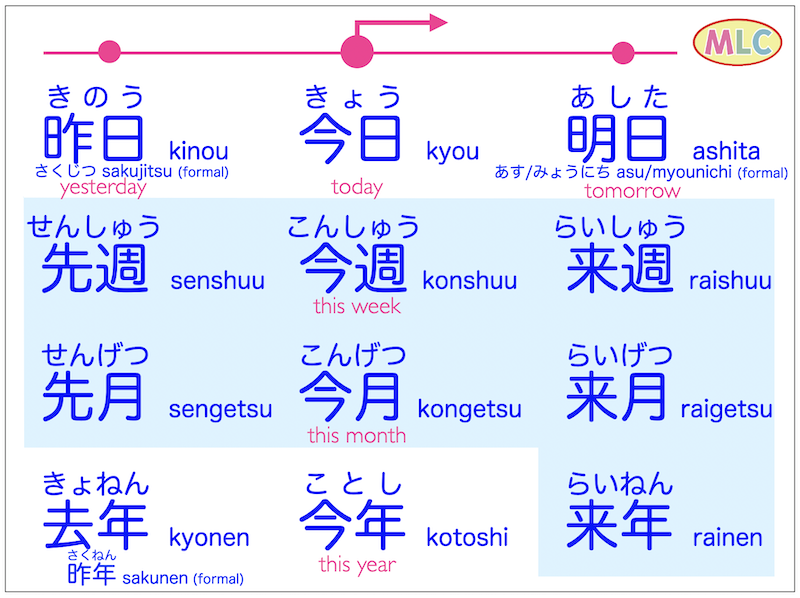
Daily Time Words: Yesterday, Today, Tomorrow (JLPT N5)
Learn how to say yesterday, today, and tomorrow in Japanese with hiragana,
romaji, and English meanings.
Use these basic time words to talk about your schedule, make plans, and
describe what you did.
- 昨日 きのう kinou = yesterday
- 今日 きょう kyou = today
- 明日 あした ashita = tomorrow
Weekly, Monthly, and Yearly Time Expressions
Expand your Japanese time vocabulary with words for last week, this week,
next week, as well as last month, this month, and next year.
These expressions are very common in daily conversation, schedules, and
JLPT N5 listening questions.
- 先週 せんしゅう senshuu = last week
- 今週 こんしゅう konshuu = this week
- 来週 らいしゅう raishuu = next week
- 先月 せんげつ sengetsu = last month
- 今月 こんげつ kongetsu = this month
- 来月 らいげつ raigetsu = next moth
- 去年 きょねん kyonen = last year
- 今年 ことし kotoshi = this year
- 来年 らいねん rainen = next year
This video lesson reviews the same Japanese time expressions with audio, so you can practice listening and pronunciation.
Using the Particle “ni” with Time Words
Find out when you should omit the particle “ni” after time expressions
like ashita and kinou.
Compare natural and unnatural example sentences to avoid common mistakes
and sound more natural in Japanese.
Q: Does'ashita' take 'ni'?
A: No
Normally, these words do not take particle “ni”.
ex.
あした がっこうに いきます。Ashita gakkou ni ikimasu. = I will go to school tomorrow. ← ○
あしたに がっこうに いきます。Ashitanigakkou ni ikimasu. ← X
きのう レストランに いきました。Kinou resutoran ni ikimashita. =I went to a restaurant yesterday. ← ○
きのうに レストランに いきました。Kinouniresutoran ni ikimashita. ← X
○= OK
X = no good
Latest Updates (Jan 2026)
• Rewrote all example sentences for natural Japanese
• Standardized romaji and English translation format
• Improved table layout for better readability